Robot Dynamics & Control: Lecture 2 - Rigid Motions and Homogeneous Transforms
Introduction
Robot kinematics is concerned with establishing the various coordinate systems used to represent the positions and orientations of rigid objects, and with the transformations among these coordinate frames.
Homogeneous transformations combine the operations of rotation and translation into a single matrix multiplication, and this is what is used to derive the forward kinematic equations: one matrix expresses both the position and the orientation of one frame relative to another.
Representing Positions
In robotics it is necessary to specify a coordinate frame before the coordinates of a point can be assigned. A point corresponds to a specific location in space, whereas a vector specifies a direction and a magnitude:
$$ v^0_1 = \begin{bmatrix} 5 \\ 6 \end{bmatrix} $$Representing Rotations
Rotation in the plane
The orientation matrix specifies the coordinate vectors for the axes of frame $o_1 x_1 y_1$ with respect to the coordinate frame $o_0 x_0 y_0$:
$$ \begin{aligned} R^0_1 &= \begin{bmatrix} x^0_1 & y^0_1 \end{bmatrix} \\ &= \begin{bmatrix} \cos\theta & -\sin\theta \\ \sin\theta & \cos\theta \end{bmatrix} \end{aligned} $$An alternative approach uses the dot product of two unit vectors; physically, each entry is the projection of one axis onto another (for example $x_1$ projected onto $x_0$):
$$ \begin{aligned} R^0_1 &= \begin{bmatrix} x^0_1 & y^0_1 \end{bmatrix} \\ &= \begin{bmatrix} x_1 \cdot x_0 & y_1 \cdot x_0 \\ x_1 \cdot y_0 & y_1 \cdot y_0 \end{bmatrix} \\ &= \left(R^1_0\right)^{-1} \end{aligned} $$Note: the column vectors are of unit length and mutually orthogonal.
Rotations in three dimensions
The projection technique scales naturally to the three-dimensional case:
$$ \begin{aligned} R^0_1 &= \begin{bmatrix} x^0_1 & y^0_1 & z^0_1 \end{bmatrix} \\ &= \begin{bmatrix} x_1 \cdot x_0 & y_1 \cdot x_0 & z_1 \cdot x_0 \\ x_1 \cdot y_0 & y_1 \cdot y_0 & z_1 \cdot y_0 \\ x_1 \cdot z_0 & y_1 \cdot z_0 & z_1 \cdot z_0 \end{bmatrix} \in SO(3) \end{aligned} $$Example 2.1
Suppose the frame $o_1 x_1 y_1 z_1$ is rotated through an angle $\theta$ about the $z_0$ axis, and we wish to find the resulting transformation matrix $R^0_1$. Note that by convention the positive sense of the angle is given by the right-hand rule: a positive rotation about the $z$-axis would advance a right-hand threaded screw along the positive $z$-axis.
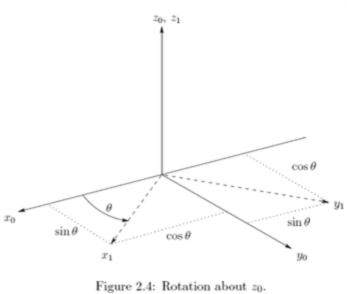
Thus
$$ R^0_1 = \begin{bmatrix} \cos\theta & -\sin\theta & 0 \\ \sin\theta & \cos\theta & 0 \\ 0 & 0 & 1 \end{bmatrix} \in SO(3) $$The basic rotation matrices
$$ R_{z,\theta} = \begin{bmatrix} \cos\theta & -\sin\theta & 0 \\ \sin\theta & \cos\theta & 0 \\ 0 & 0 & 1 \end{bmatrix}, \quad R_{x,\theta} = \begin{bmatrix} 1 & 0 & 0 \\ 0 & \cos\theta & -\sin\theta \\ 0 & \sin\theta & \cos\theta \end{bmatrix}, \quad R_{y,\theta} = \begin{bmatrix} \cos\theta & 0 & \sin\theta \\ 0 & 1 & 0 \\ -\sin\theta & 0 & \cos\theta \end{bmatrix} $$ $$ \begin{aligned} R_{z,0} &= I \\ R_{z,\theta} R_{z,\phi} &= R_{z,\theta+\phi} \\ R^{-1}_{z,\theta} &= R_{z,-\theta} \end{aligned} $$Rotational Transformations
We wish to determine the coordinates of a point $p$ relative to a fixed reference frame $o_0 x_0 y_0 z_0$, given its expression in $o_1 x_1 y_1 z_1$:
$$ p = u x_1 + v y_1 + w z_1 $$Projecting $p$ onto each axis of the reference frame $o_0 x_0 y_0 z_0$ gives
$$ p^0 = \begin{bmatrix} p \cdot x_0 \\ p \cdot y_0 \\ p \cdot z_0 \end{bmatrix} $$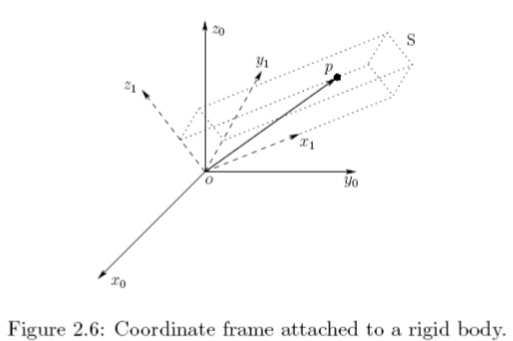
Combining these two equations,
$$ \begin{aligned} p^0 &= \begin{bmatrix} (u x_1 + v y_1 + w z_1) \cdot x_0 \\ (u x_1 + v y_1 + w z_1) \cdot y_0 \\ (u x_1 + v y_1 + w z_1) \cdot z_0 \end{bmatrix} \\ &= \begin{bmatrix} x_1 \cdot x_0 & y_1 \cdot x_0 & z_1 \cdot x_0 \\ x_1 \cdot y_0 & y_1 \cdot y_0 & z_1 \cdot y_0 \\ x_1 \cdot z_0 & y_1 \cdot z_0 & z_1 \cdot z_0 \end{bmatrix} \begin{bmatrix} u \\ v \\ w \end{bmatrix} \end{aligned} $$and finally
$$ p^0 = R^0_1 p^1 $$The rotation matrix can therefore be used not only to represent the orientation of coordinate frame $o_1 x_1 y_1 z_1$ with respect to frame $o_0 x_0 y_0 z_0$, but also to transform the coordinates of a point from one frame to another.
Composition of Rotations
Rotation with respect to the current coordinate frame
Suppose we now add a third coordinate frame $o_2 x_2 y_2 z_2$ related to the frames $o_0 x_0 y_0 z_0$ and $o_1 x_1 y_1 z_1$ by rotational transformations:
$$ \begin{aligned} p^0 &= R^0_1 p^1 \\ p^1 &= R^1_2 p^2 \\ \therefore\ p^0 &= R^0_1 R^1_2 p^2 = R^0_2 p^2 \end{aligned} $$Suppose initially that all three coordinate frames coincide. We first rotate the frame $o_1 x_1 y_1 z_1$ relative to $o_0 x_0 y_0 z_0$ according to the transformation $R^0_1$. Then, with the frames $o_1 x_1 y_1 z_1$ and $o_2 x_2 y_2 z_2$ coincident, we rotate $o_2 x_2 y_2 z_2$ relative to $o_1 x_1 y_1 z_1$ according to the transformation $R^1_2$. In each case the rotation occurs with respect to the current frame, and the corresponding matrices are post-multiplied.
Note:
It is important to remember that the order in which a sequence of rotations is carried out is crucial. A rotation matrix gives different results depending on the order of the sequence.
Rotation with respect to the fixed coordinate frame
Many times it is desirable to perform a sequence of rotations, each about a given fixed coordinate frame, rather than about successive current frames. In that case the matrices are pre-multiplied instead: if $R^0_1$ is the current orientation and a further rotation $R$ is performed about an axis of the fixed frame, the resulting orientation is $R\,R^0_1$.
Parameterization of Rotations
There are three ways in which an arbitrary rotation can be represented using only three independent quantities:
- Euler angle representation
- Roll-pitch-yaw representation
- Axis/angle representation
Euler Angles
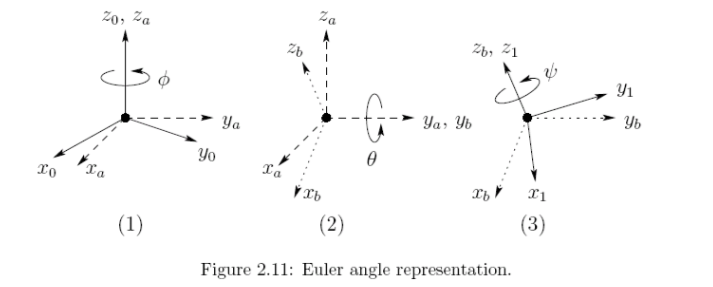
A common method of specifying a rotation matrix is by Euler angles. We can specify the orientation of the frame $o_1 x_1 y_1 z_1$ relative to the frame $o_0 x_0 y_0 z_0$ by three angles $(\phi, \theta, \psi)$, applied as follows:
- Rotation about the $z$-axis by the angle $\phi$.
- Rotation about the current $y$-axis by the angle $\theta$.
- Rotation about the current $z$-axis by the angle $\psi$.
Note
The order of the sequence can be defined in several ways, but $z$-$y$-$z$ is the common choice.
Now consider the inverse problem of determining the Euler angles $(\phi, \theta, \psi)$ given the rotation matrix
$$ \begin{aligned} R &= \begin{bmatrix} r_{11} & r_{12} & r_{13} \\ r_{21} & r_{22} & r_{23} \\ r_{31} & r_{32} & r_{33} \end{bmatrix} \\ &= \begin{bmatrix} c_{\phi}c_{\theta}c_{\psi} - s_{\phi}s_{\psi} & -c_{\phi}c_{\theta}s_{\psi} - s_{\phi}c_{\psi} & c_{\phi}s_{\theta} \\ s_{\phi}c_{\theta}c_{\psi} + c_{\phi}s_{\psi} & -s_{\phi}c_{\theta}s_{\psi} + c_{\phi}c_{\psi} & s_{\phi}s_{\theta} \\ -s_{\theta}c_{\psi} & s_{\theta}s_{\psi} & c_{\theta} \end{bmatrix} \end{aligned} $$If $r_{13}$ and $r_{23}$ are not both zero, then $s_{\theta} \neq 0$; hence $r_{31}$ and $r_{32}$ are not both zero and $r_{33} \neq \pm 1$, so
$$ \begin{aligned} \theta &= \operatorname{atan2}\!\left(\pm\sqrt{1 - r^2_{33}},\; r_{33}\right) \\ &= \operatorname{atan2}\!\left(\pm\sqrt{1 - c^2_{\theta}},\; c_{\theta}\right) \\ &= \operatorname{atan2}\!\left(\pm s_{\theta},\; c_{\theta}\right) \end{aligned} $$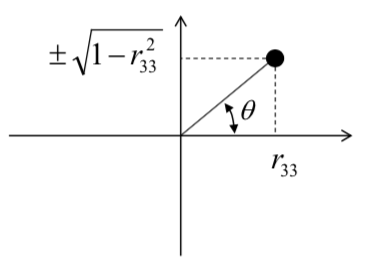
If $\theta > 0$,
$$ \begin{aligned} \phi &= \operatorname{atan2}(r_{23},\, r_{13}) \\ &= \operatorname{atan2}(s_{\phi}s_{\theta},\, c_{\phi}s_{\theta}) \\[6pt] \psi &= \operatorname{atan2}(r_{32},\, -r_{31}) \\ &= \operatorname{atan2}(s_{\theta}s_{\psi},\, s_{\theta}c_{\psi}) \end{aligned} $$If $\theta < 0$,
$$ \begin{aligned} \phi &= \operatorname{atan2}(-r_{23},\, -r_{13}) \\ &= \operatorname{atan2}(-s_{\phi}s_{\theta},\, -c_{\phi}s_{\theta}) \\[6pt] \psi &= \operatorname{atan2}(-r_{32},\, r_{31}) \\ &= \operatorname{atan2}(-s_{\theta}s_{\psi},\, -s_{\theta}c_{\psi}) \end{aligned} $$If $r_{13} = r_{23} = 0$, then $r_{33} = \pm 1$ by orthogonality:
$$ R = \begin{bmatrix} r_{11} & r_{12} & 0 \\ r_{21} & r_{22} & 0 \\ 0 & 0 & \pm 1 \end{bmatrix} $$Case $r_{33} = 1$
Then $c_{\theta} = 1$, $s_{\theta} = 0$ and $\theta = 0$:
$$ \begin{aligned} \begin{bmatrix} c_{\phi}c_{\theta}c_{\psi} - s_{\phi}s_{\psi} & -c_{\phi}c_{\theta}s_{\psi} - s_{\phi}c_{\psi} & c_{\phi}s_{\theta} \\ s_{\phi}c_{\theta}c_{\psi} + c_{\phi}s_{\psi} & -s_{\phi}c_{\theta}s_{\psi} + c_{\phi}c_{\psi} & s_{\phi}s_{\theta} \\ -s_{\theta}c_{\psi} & s_{\theta}s_{\psi} & c_{\theta} \end{bmatrix} &= \begin{bmatrix} c_{\phi}c_{\psi} - s_{\phi}s_{\psi} & -c_{\phi}s_{\psi} - s_{\phi}c_{\psi} & 0 \\ s_{\phi}c_{\psi} + c_{\phi}s_{\psi} & -s_{\phi}s_{\psi} + c_{\phi}c_{\psi} & 0 \\ 0 & 0 & 1 \end{bmatrix} \\ &= \begin{bmatrix} c_{\phi+\psi} & -s_{\phi+\psi} & 0 \\ s_{\phi+\psi} & c_{\phi+\psi} & 0 \\ 0 & 0 & 1 \end{bmatrix} \\ &= \begin{bmatrix} r_{11} & r_{12} & 0 \\ r_{21} & r_{22} & 0 \\ 0 & 0 & 1 \end{bmatrix} \\[6pt] \because\ \sin(\alpha \pm \beta) &= \sin\alpha \cos\beta \pm \cos\alpha \sin\beta \\ \cos(\alpha \pm \beta) &= \cos\alpha \cos\beta \mp \sin\alpha \sin\beta \end{aligned} $$Thus
$$ \begin{aligned} \phi + \psi &= \operatorname{atan2}(r_{21},\, r_{11}) \\ &= \operatorname{atan2}(-r_{12},\, r_{11}) \end{aligned} $$Only the sum $\phi + \psi$ is determined, so there are infinitely many solutions.
Case $r_{33} = -1$
Then $c_{\theta} = -1$, $s_{\theta} = 0$ and $\theta = \pi$:
$$ \begin{aligned} \begin{bmatrix} -c_{\phi-\psi} & -s_{\phi-\psi} & 0 \\ -s_{\phi-\psi} & c_{\phi-\psi} & 0 \\ 0 & 0 & -1 \end{bmatrix} &= \begin{bmatrix} r_{11} & r_{12} & 0 \\ r_{21} & r_{22} & 0 \\ 0 & 0 & -1 \end{bmatrix} \\[6pt] \because\ \sin(\alpha \pm \beta) &= \sin\alpha \cos\beta \pm \cos\alpha \sin\beta \\ \cos(\alpha \pm \beta) &= \cos\alpha \cos\beta \mp \sin\alpha \sin\beta \end{aligned} $$Thus
$$ \begin{aligned} \phi - \psi &= \operatorname{atan2}(-r_{12},\, -r_{11}) \\ &= \operatorname{atan2}(-r_{21},\, r_{22}) \end{aligned} $$Again only the difference $\phi - \psi$ is determined, so there are infinitely many solutions.
Roll, Pitch, Yaw Angles
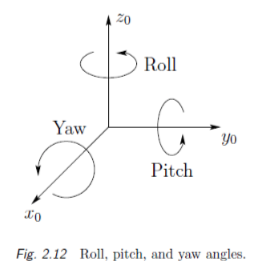
A rotation matrix $R$ can also be described as a product of successive rotations about the principal coordinate axes $x_0$, $y_0$, $z_0$. These rotations define the roll, pitch and yaw angles $(\phi, \theta, \psi)$. The rotation order is:
- $x_0 \rightarrow y_0 \rightarrow z_0$ from the fixed (global) frame perspective, where the matrices are pre-multiplied.
- $z \rightarrow y \rightarrow x$ from the current frame perspective, where the matrices are post-multiplied.
Both readings produce the same product $R_{z,\phi} R_{y,\theta} R_{x,\psi}$.
Note
Here the order of the sequence is $z$-$y$-$x$, but $x$-$y$-$z$ is an equally valid definition.
Consider the inverse problem of determining the roll, pitch and yaw angles $\phi$, $\theta$, $\psi$ given the rotation matrix
$$ \begin{aligned} R &= \begin{bmatrix} r_{11} & r_{12} & r_{13} \\ r_{21} & r_{22} & r_{23} \\ r_{31} & r_{32} & r_{33} \end{bmatrix} \\ &= \begin{bmatrix} c_{\phi}c_{\theta} & -s_{\phi}c_{\psi} + c_{\phi}s_{\theta}s_{\psi} & s_{\phi}s_{\psi} + c_{\phi}s_{\theta}c_{\psi} \\ s_{\phi}c_{\theta} & c_{\phi}c_{\psi} + s_{\phi}s_{\theta}s_{\psi} & -c_{\phi}s_{\psi} + s_{\phi}s_{\theta}c_{\psi} \\ -s_{\theta} & c_{\theta}s_{\psi} & c_{\theta}c_{\psi} \end{bmatrix} \end{aligned} $$The solution is
$$ \begin{aligned} \phi &= \operatorname{atan2}(r_{21},\, r_{11}) & &\text{if } -\tfrac{\pi}{2} < \theta < \tfrac{\pi}{2} \\ &= \operatorname{atan2}(-r_{21},\, -r_{11}) & &\text{if } \theta < -\tfrac{\pi}{2} \ \text{ or } \ \theta > \tfrac{\pi}{2} \\[6pt] \theta &= \operatorname{atan2}\!\left(-r_{31},\; c_{\phi}r_{11} + s_{\phi}r_{21}\right) \\ &= \operatorname{atan2}\!\left(s_{\theta},\; c_{\theta}\left(c^2_{\phi} + s^2_{\phi}\right)\right) \\[6pt] \psi &= \operatorname{atan2}\!\left(s_{\phi}r_{13} - c_{\phi}r_{23},\; -s_{\phi}r_{12} + c_{\phi}r_{22}\right) \\ &= \operatorname{atan2}\!\left(s_{\psi}\left(s^2_{\phi} + c^2_{\phi}\right) + s_{\phi}c_{\phi}s_{\theta}c_{\psi} - c_{\phi}s_{\phi}s_{\theta}c_{\psi},\; c_{\psi}\left(s^2_{\phi} + c^2_{\phi}\right) + s_{\phi}c_{\phi}s_{\theta}s_{\psi} - c_{\phi}s_{\phi}s_{\theta}s_{\psi}\right) \end{aligned} $$If $\theta = \pm\frac{\pi}{2}$ there is no unique solution, so we generally assume that $-\frac{\pi}{2} < \theta < \frac{\pi}{2}$.
Homogeneous Transformations
In this section we combine position (translation) and orientation to define homogeneous transformations. If frame $o_1 x_1 y_1 z_1$ is obtained from frame $o_0 x_0 y_0 z_0$ by first applying a rotation specified by $R^0_1$ followed by a translation given (with respect to $o_0 x_0 y_0 z_0$) by $d^0_1$, then the coordinates $p^0$ are given by
$$ p^0 = R^0_1 p^1 + d^0_1 $$A transformation of this form is said to define a rigid motion if $R$ is orthogonal. Consider two such rigid motions:
$$ \begin{aligned} p^0 &= R^0_1 p^1 + d^0_1 \\ p^1 &= R^1_2 p^2 + d^1_2 \end{aligned} $$Their composition defines a third rigid motion:
$$ \begin{aligned} p^0 &= R^0_1 \left(R^1_2 p^2 + d^1_2\right) + d^0_1 \\ &= R^0_2 p^2 + R^0_1 d^1_2 + d^0_1 \end{aligned} $$Since the relationship between $p^0$ and $p^2$ is also a rigid motion,
$$ p^0 = R^0_2 p^2 + d^0_2 $$so we have the relationships
$$ \begin{aligned} R^0_2 &= R^0_1 R^1_2 \\ d^0_2 &= d^0_1 + R^0_1 d^1_2 \end{aligned} $$where $d^0_1$ is the vector from $o_0$ to $o_1$ expressed in $o_0 x_0 y_0 z_0$, and $R^0_1 d^1_2$ is the vector from $o_1$ to $o_2$ expressed in the orientation of $o_0 x_0 y_0 z_0$.
The same composition is obtained by a single $4 \times 4$ matrix product, where $0$ denotes the row vector $\begin{bmatrix} 0 & 0 & 0 \end{bmatrix}$:
$$ \begin{aligned} \begin{bmatrix} R^0_1 & d^0_1 \\ 0 & 1 \end{bmatrix} \begin{bmatrix} R^1_2 & d^1_2 \\ 0 & 1 \end{bmatrix} &= \begin{bmatrix} R^0_1 R^1_2 & R^0_1 d^1_2 + d^0_1 \\ 0 & 1 \end{bmatrix} \\ &= \begin{bmatrix} R^0_2 & R^0_1 d^1_2 + d^0_1 \\ 0 & 1 \end{bmatrix} \end{aligned} $$The homogeneous transformation is therefore
$$ H = \begin{bmatrix} R & d \\ 0 & 1 \end{bmatrix}; \qquad R \in SO(3),\ d \in \mathbb{R}^3 $$and, using the fact that $R$ is orthogonal,
$$ H^{-1} = \begin{bmatrix} R^T & -R^T d \\ 0 & 1 \end{bmatrix} $$In order to use the homogeneous transformation we need to augment the vectors $p$ by the addition of a fourth component equal to $1$, giving the homogeneous representation
$$ P^0 = \begin{bmatrix} p^0 \\ 1 \end{bmatrix}, \qquad P^1 = \begin{bmatrix} p^1 \\ 1 \end{bmatrix} $$so that the rigid motion becomes a single matrix product:
$$ \begin{aligned} p^0 &= R^0_1 p^1 + d^0_1 \\[6pt] P^0 &= H^0_1 P^1 \end{aligned} $$A set of basic homogeneous transformations is
$$ \begin{aligned} Trans_{x,a} &= \begin{bmatrix} 1 & 0 & 0 & a \\ 0 & 1 & 0 & 0 \\ 0 & 0 & 1 & 0 \\ 0 & 0 & 0 & 1 \end{bmatrix}; & Rot_{x,\alpha} &= \begin{bmatrix} 1 & 0 & 0 & 0 \\ 0 & c_{\alpha} & -s_{\alpha} & 0 \\ 0 & s_{\alpha} & c_{\alpha} & 0 \\ 0 & 0 & 0 & 1 \end{bmatrix} \\ Trans_{y,b} &= \begin{bmatrix} 1 & 0 & 0 & 0 \\ 0 & 1 & 0 & b \\ 0 & 0 & 1 & 0 \\ 0 & 0 & 0 & 1 \end{bmatrix}; & Rot_{y,\beta} &= \begin{bmatrix} c_{\beta} & 0 & s_{\beta} & 0 \\ 0 & 1 & 0 & 0 \\ -s_{\beta} & 0 & c_{\beta} & 0 \\ 0 & 0 & 0 & 1 \end{bmatrix} \\ Trans_{z,c} &= \begin{bmatrix} 1 & 0 & 0 & 0 \\ 0 & 1 & 0 & 0 \\ 0 & 0 & 1 & c \\ 0 & 0 & 0 & 1 \end{bmatrix}; & Rot_{z,\gamma} &= \begin{bmatrix} c_{\gamma} & -s_{\gamma} & 0 & 0 \\ s_{\gamma} & c_{\gamma} & 0 & 0 \\ 0 & 0 & 1 & 0 \\ 0 & 0 & 0 & 1 \end{bmatrix} \end{aligned} $$Note
The result of a homogeneous transformation is different depending on the order of the sequence.
The most general homogeneous transformation is
$$ H^0_1 = \begin{bmatrix} n_x & s_x & a_x & d_x \\ n_y & s_y & a_y & d_y \\ n_z & s_z & a_z & d_z \\ 0 & 0 & 0 & 1 \end{bmatrix} = \begin{bmatrix} n & s & a & d \\ 0 & 0 & 0 & 1 \end{bmatrix} $$- $n = (n_x, n_y, n_z)^T$: direction of $x_1$ in $o_0 x_0 y_0 z_0$.
- $s = (s_x, s_y, s_z)^T$: direction of $y_1$ in $o_0 x_0 y_0 z_0$.
- $a = (a_x, a_y, a_z)^T$: direction of $z_1$ in $o_0 x_0 y_0 z_0$.
- $d = (d_x, d_y, d_z)^T$: vector from $o_0$ to the origin $o_1$ in $o_0 x_0 y_0 z_0$.